Erectile Dysfunction and Relationships: How to Talk About It With Your Partner
If you are here, you may be carrying a quiet worry that feels hard to name.
Erectile dysfunction (ED) can bring up embarrassment, fear, and a kind of loneliness that doesn’t always make sense especially when you love each other.
For many couples, the hardest part isn’t the moment itself. Its what happens around it:
- the silence afterward
- the tension the next time you try
- the stories you start telling yourself (Maybe I’m not wanted, Maybe I’m failing)
This is a relationship article not medical advice. I’m not here to diagnose. I’m here to help you talk about erectile dysfunction and relationships in a way that protects dignity and keeps you on the same side.
A note for Silicon Valley couples
In Silicon Valley, many couples are living inside a high-performance culture: long hours, constant thinking, and nervous systems that rarely get to fully downshift.
When stress becomes chronic, intimacy can start to feel like another place you’re expected to perform.
If ED has entered your relationship, it doesn’t mean your relationship is broken. It may mean your body is asking for gentleness and your relationship is asking for a new kind of conversation.
Why erectile dysfunction can feel so personal in a relationship
ED is often interpreted as a message:
- You’re not attractive.
- You’re not enough.
- Something is wrong with me.
But erections are not a simple measure of love, desire, or commitment.
Erectile dysfunction can be influenced by stress, anxiety, sleep, health factors, hormones, medication, relationship tension, and the pressure to get it right.
And pressure is the opposite of intimacy.
When couples don’t talk about it, the gap fills with assumptions. That’s when ED starts to damage the relationship not because it exists, but because it becomes unspeakable.
Start with the relationship, not the mechanics
A common mistake is to lead with the problem:
- Why is this happening?
- What’s wrong?
Even when asked with love, those questions can land like an interrogation.
A better opening is the bond:
- reassurance
- partnership
- curiosity
A reframe that helps couples stay close
Instead of: This is happening to you. Try: This is happening to us, and we can face it together.
That shift reduces shame and shame is often the biggest intimacy killer in the room.
Choose the right moment to talk (timing matters)
The best time to talk about ED is usually not:
- in the bedroom
- during an attempt at sex
- immediately after a difficult moment
Pick a neutral moment like a walk, a quiet evening, a calm weekend morning.
You can start with:
I’d like to talk about something tender. Is now okay, or should we choose a better time?
That sentence communicates respect before you say anything else.
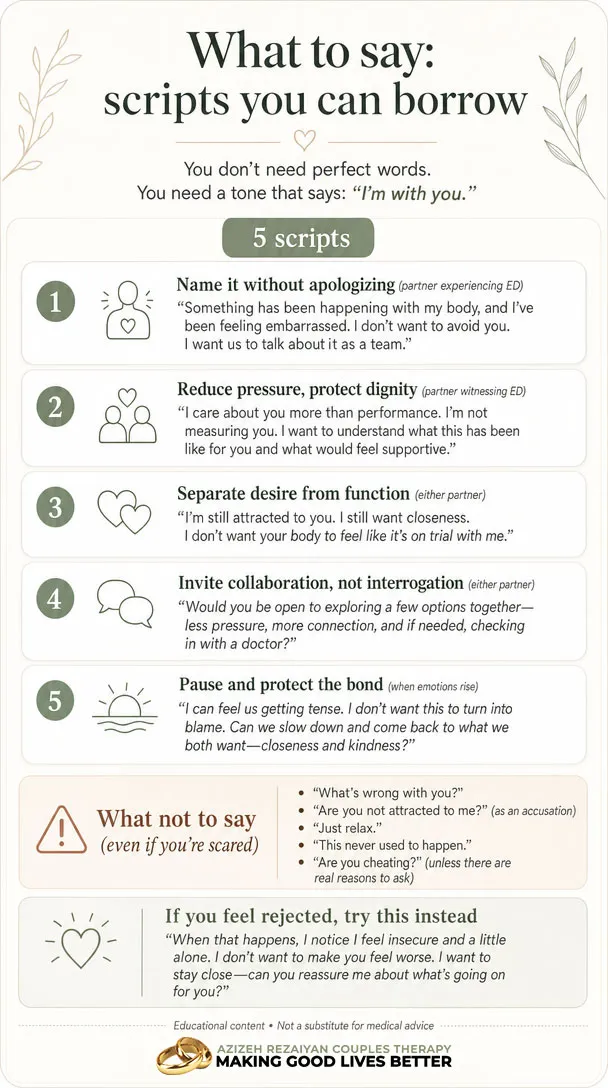
5 scripts you can borrow
You don’t need perfect words. You need a tone that says: I’m with you.
Script 1 (partner experiencing ED): name it without apologizing
Something has been happening with my body, and I’ve been feeling embarrassed. I don’t want to avoid you. I want us to talk about it as a team.
Script 2 (partner witnessing ED): reduce pressure, protect dignity
I care about you more than performance. I’m not measuring you. I want to understand what this has been like for you and what would feel supportive.
Script 3 (either partner): separate desire from function
I’m still attracted to you. I still want closeness. I don’t want your body to feel like its on trial with me.
Script 4 (either partner): invite collaboration, not interrogation
Would you be open to exploring a few options togetherness pressure, more connection, and if needed, checking in with a doctor?
Script 5 (when emotions rise): pause and protect the bond
I can feel us getting tense. I don’t want this to turn into blame. Can we slow down and come back to what we both want closeness and kindness?
What not to say (even if you are scared)
Sometimes the most painful moments aren’t ED itself they’re what gets said around it.
Try to avoid:
- What’s wrong with you?
- Are you not attracted to me? (as an accusation)
- Just relax.
- This never used to happen.
- Are you cheating? (unless there are real reasons to ask)
If you feel rejected, try this instead
When that happens, I notice I feel insecure and a little alone. I don’t want to make you feel worse. I want to stay close can you reassure me about what’s going on for you?
If your partner shuts down or avoids the topic
Avoidance is often self-protection.
If the partner experiencing ED goes quiet, it may be because they feel ashamed or afraid of disappointing you.
A softer reopening can sound like:
I can tell this is hard to talk about. I’m not asking for a full conversation right now. I just want you to know I’m on your side. When you’re ready, Id like us to talk.
Then follow through by staying kind not punishing with coldness.
Rebuilding intimacy beyond intercourse.
One of the most helpful shifts for erectile dysfunction and relationships is expanding what intimacy means.
Many couples accidentally make intercourse the main event, and everything else becomes a warm-up that feels pointless if intercourse doesn’t happen.
That structure creates pressure.
Instead, think of intimacy as a menu – connection can be the goal, not a specific outcome.
Meaning: rather than treating sex like a pass/fail performance (erection = success, no erection = failure), you frame intimacy as many valid options—touch, kissing, talking, laughing, sensual massage, showering together, mutual pleasure, or simply holding each other. The “win” becomes staying connected, not forcing one particular result.
Low-pressure ways to reconnect
- Affection with no agenda: kissing, holding, cuddling, massage
- Sensuality without performance: slow touch, showering together, making out
- Playfulness: flirting, humor, novelty
- Emotional intimacy: sharing fears, hopes, appreciation
A simple agreement that reduces anxiety
Tonight, there is no goal. Were not trying to get somewhere. Were just being close.
When to consider medical support (without making it scary)
Because ED can have physical contributors, it can be wise to consult a physician especially if its new, persistent, or concerning.
If you’d like a reputable overview, you can read the Mayo Clinics page on erectile dysfunction:
The goal isn’t to catastrophize. Its to get clarity and support.
How therapy can help when ED is affecting the relationship
Sometimes ED is the visible issue, but the deeper pattern is:
- pressure
- perfectionism
- fear of disappointing each other
- difficulty talking about vulnerability
- resentment or disconnection that has been building quietly
In couples therapy, the goal isn’t to fix someone.
Its to help you:
- talk about sex and intimacy without shame
- rebuild emotional safety
- understand what each of you is protecting
- create a shared language for reassurance and desire
If you’re curious about the research on what helps couples stay connected during stress and conflict, the PsychologyToday has accessible, evidence-informed resources.
And if you resonate with Emotionally Focused Therapy (EFT), you may appreciate learning more about the attachment-based approach many couples find deeply stabilizing.
FAQ
Does ED mean my partner isn’t attracted to me?
Not necessarily. Attraction and erectile response are related, but they are not identical. Stress, anxiety, health factors, and pressure can interrupt arousal even in loving relationships.
How do I bring it up without embarrassing my partner?
Choose a neutral moment, lead with care, and speak in we language. Aim for dignity: I’m on your side lands better than Explain yourself.
What if I feel rejected or undesirable?
That feeling is real and it deserves tenderness. Try naming it without blaming: I notice I feel insecure when this happens, and Id love reassurance.
When should we get professional help?
If the topic keeps turning into conflict, avoidance, or distance or if either of you feels stuck in shame support can help. Medical support can address health factors; couples therapy can address the emotional and relational layer.
Book a consultation (Silicon Valley)
If you and your partner want help navigating intimacy, pressure, and communication with warmth and clarity, I offer private couples therapy in Silicon Valley (Menlo Park Palo Alto San Jose).
Book a consultation here: https://azizehrezaiyancouplestherapy.com/silicon-valley/schedule-a-20-minute-consultation/