How to Get Through Hard Times as a Couple (Silicon Valley)
Hard times don’t just test a relationship they reveal it.
When life gets heavy (work stress, parenting strain, health worries, money pressure, grief), even strong couples can start to feel like they’re failing. You may argue more, withdraw more, or quietly stop reaching for each other.
If that’s happening, it doesn’t mean your relationship is broken. It usually means your nervous systems are overloaded and you need a few steady practices that help you stay on the same team.
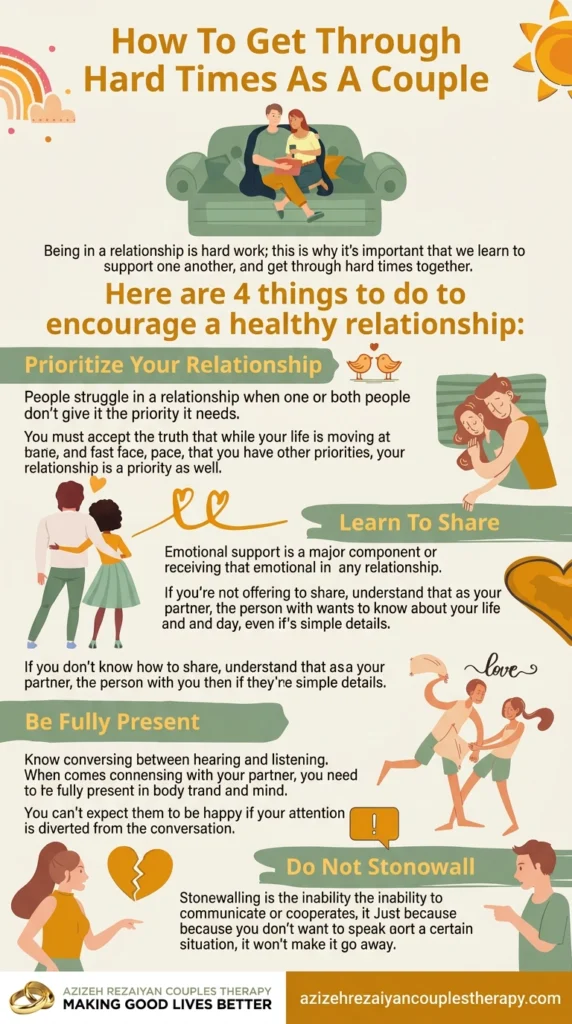
Below are four grounded ways to get through hard times as a couple, adapted from the infographic on this page.
1) Prioritize your relationship (even when life is loud)
When you’re under pressure, its easy for the relationship to become the place where you borrow time from because it feels flexible.
But connection is not a luxury. Its what helps you function.
Try one small commitment for the next two weeks:
- A 10-minute daily check-in (no phones)
- One shared meal or walk
- One admin meeting for logistics so it doesn’t leak into every conversation
If you’re in Silicon Valley, this step matters even more. High-performing schedules can make disconnection feel normal until it doesn’t.
If you want support rebuilding connection and teamwork, couples counseling can help.
2) Learn to share (emotional support, not just information)
Many couples can coordinate a calendar but struggle to share what’s happening inside.
In hard seasons, emotional support is often the missing ingredient.
Try simple, specific sharing:
- One thing that’s been hard for me is
- The story my mind is making up is
- What I need from you tonight is
And if you’re the listening partner, aim for presence before solutions:
- That makes sense.
- I’m here.
- Do you want comfort or ideas?
3) Be fully present (listen with your whole body)
When couples are stressed, attention gets fragmented and the relationship starts to feel like an interruption.
Presence doesn’t mean long talks. It means undivided moments.
Try:
- Put phones away for 10 minutes
- Make eye contact when your partner starts a sentence
- Reflect back what you heard before responding
If anxiety is fueling reactivity, worry spirals, or shutdown, anxiety support can help you feel steadier day-to-day.
For practical guidance on managing stress, the APA has a helpful overview:
4) Do not stonewall (pause without disappearing)
Stonewalling is when a conversation ends not because its resolved but because one partner shuts down, goes silent, leaves, or refuses to engage.
Sometimes it looks like:
- Whatever.
- Silence
- Walking away mid-sentence
- I’m done.
Often, stonewalling is overwhelm not cruelty.
A healthier alternative is a structured pause:
- I’m getting flooded. I need 20 minutes to calm down.
- I’m coming back. I’m not abandoning this.
- Let’s try again after dinner.
If trust has been strained (including betrayal or gray zone behavior), support can help you rebuild safety sooner rather than later.
When hard times keep repeating
Consider professional support if:
- You’re stuck in the same fight every week
- One or both of you shuts down quickly
- You feel lonely in the relationship
- Intimacy has faded and you don’t know how to restart
If you’re curious about evidence-based couples therapy, here’s a clear overview of Emotionally Focused Therapy (EFT):
Ready for support?
If you want a calm, confidential space to help you get through a hard season and come back to each other, you can schedule a 20-minute consultation here.
FAQs
How do couples get through hard times together?
By prioritizing connection, sharing emotions (not just logistics), staying present, and taking structured pauses instead of shutting down.
What does it mean to prioritize your relationship?
It means protecting small rituals of connection even during busy or stressful seasons so you don’t drift into roommate mode.
What if my partner won’t talk about feelings?
Start small and specific. Ask for one feeling and one need. If conversations keep shutting down, therapy can help create safety for emotional sharing.
What is stonewalling in a relationship?
Stonewalling is shutting down or refusing to engage during conflict. Its often a sign of overwhelm. A structured pause is a healthier alternative.
How can we communicate better when were stressed?
Use shorter conversations, reflect back what you heard, and ask whether your partner wants comfort or solutions.
When should we get couples counseling?
When conflict repeats, emotional distance grows, or you feel stuck. Counseling can help you rebuild teamwork and connection before things worsen.