Remote Work Is Straining Your Relationship — Here’s What Helps (Silicon Valley)
Remote work can quietly strain a relationship—because home becomes the office, and there’s no real “off switch.” You can be together all day, yet emotionally far apart: screens, deadlines, interruptions, and the slow buildup of unequal load.
If you’re feeling more like roommates than partners, you’re not alone. The good news is: you don’t need a dramatic overhaul. You need a few steady practices that protect connection while life is loud.
Silicon Valley Remote Work Stress: Why It Hits Couples Differently
In Silicon Valley, stress often looks “high-functioning” from the outside—long hours, constant context-switching, and pressure to stay productive. But inside a relationship, that pace can translate into irritability, emotional distance, and intimacy fading—not because love is gone, but because your nervous system is overloaded.
1) Name the stress (so you stop blaming each other)
Under pressure, your nervous system looks for a cause. Often, the closest person becomes the easiest target.
Try naming the real thing:
- “Work has been living in my body lately.”
- “I’m overwhelmed, not angry at you.”
- “I miss us. I want to find our way back.”
This shifts you from me vs. you to us vs. the stress.
If you’re stuck in the same conflict loop—pursuing, withdrawing, snapping, shutting down—couples counseling can help you slow the cycle and rebuild emotional safety.
2) Create remote-work boundaries inside the home
A lot of work-from-home conflict isn’t about love—it’s about friction:
- Interruptions during meetings
- Noise and space issues
- Invisible labor (who notices what needs doing?)
- One person carrying the mental load
Try two small agreements:
- Office hours: “From 9–12 I’m heads-down unless it’s urgent.”
- A daily reset: 10 minutes after work to transition (no logistics talk yet).
Boundaries aren’t cold. They’re protective.
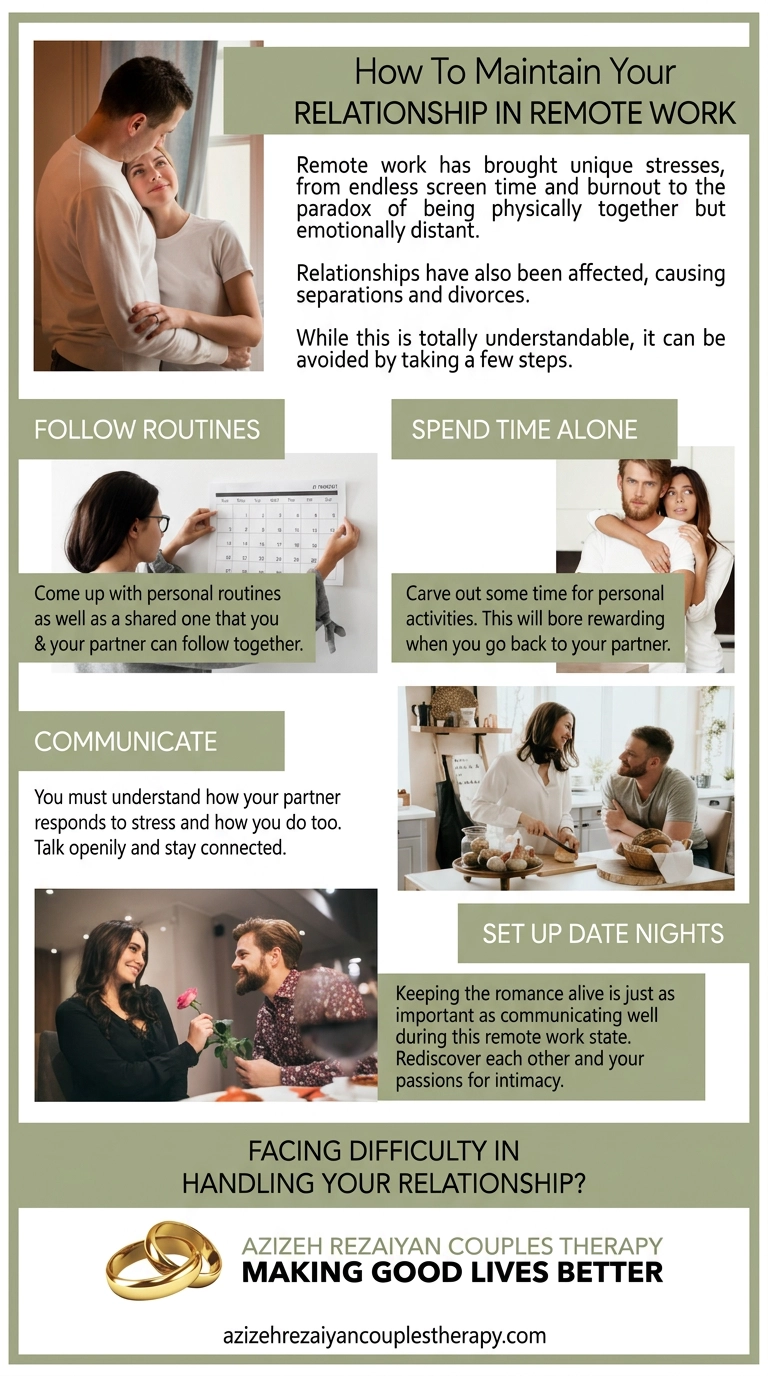
3) Follow routines that protect the relationship (not just productivity)
When life is stressful, routines become emotional shelter.
Pick 1–2 rituals for the week:
- A 10-minute check-in (no phones)
- A short walk after work
- A shared meal, even if it’s simple
- One “admin meeting” for logistics so it doesn’t leak into every moment
Routines aren’t romantic. They’re stabilizing. And stability is what intimacy grows from.
For research-based tools that support connection and conflict repair: Gottman relationship resources: https://www.gottman.com/couples/
4) Spend time alone (so you can come back calmer)
When you’re in the same space all day, alone time becomes essential—not as distance, but as regulation.
Try:
- 20–60 minutes of decompression after work
- A solo walk
- A clear phrase like: “I need a pause. I’m not leaving you—I’m calming down.”
If anxiety is driving irritability, rumination, or shutdown, anxiety support can help you feel steadier day-to-day. anxiety support: https://azizehrezaiyancouplestherapy.com/silicon-valley/anxiety-counseling/
5) Communicate in smaller, safer ways (especially when you’re burnt out)
Burnout makes long talks feel impossible. So don’t start with a “big conversation.”
Start with a small one:
- “Can I share one feeling?”
- “Can you hold me for a minute before we problem-solve?”
- “What would help you feel supported this week?”
Short, honest, kind. That’s the goal.
6) When remote work kills libido (and what helps without pressure)
This is one of the most common remote-work realities: constant proximity + constant stress can lower desire.
A libido drop doesn’t automatically mean the relationship is failing. Often it means:
- Your body is in survival mode
- You’re emotionally flooded
- You’re carrying resentment or exhaustion
- You don’t have privacy, novelty, or recovery time
Two gentle moves that help:
- Shift the goal from sex to closeness (touch, warmth, presence).
- Make space for desire to return (rest, alone time, playful connection).
If you want a reputable medical overview of low libido (without shame)
7) If trust is strained, get support sooner (not later)
Stress can expose cracks that were already there—especially around secrecy, emotional distance, or betrayal.
If there has been infidelity (or “gray zone” behavior that broke trust), you deserve support that helps you rebuild clarity and self-trust—not just “move on.” support after infidelity.
If you’re curious about Emotionally Focused Therapy (EFT), a well-known evidence-based approach for couples.
8) Don’t isolate—strengthen your support network
Stress thrives in isolation. Connection helps your nervous system settle.
The APA has practical guidance on stress and coping:
- APA stress tips: https://www.apa.org/topics/stress/tips
- APA: strengthen your support network: https://www.apa.org/topics/stress/manage-social-support
If stress is escalating into something heavier, local support is also available:
- Santa Clara County Behavioral Health: https://bhsd.sccgov.org/
- NAMI Santa Clara County: https://namisantaclara.org/
Ready for support?
If you want a calm, confidential space to help you protect your relationship during remote work stress—emotional distance, resentment, and intimacy changes included—you can schedule a 20-minute consultation here: schedule a 20-minute consultation: https://azizehrezaiyancouplestherapy.com/silicon-valley/schedule-a-20-minute-consultation/
FAQs
How can we maintain our relationship during stress?
Use small rituals, clear boundaries, and short check-ins. Stress makes couples reactive; stability and kindness reduce the cycle.
Why does remote work create relationship conflict?
Because boundaries blur. Interruptions, unequal household load, and constant proximity can create friction and resentment.
How do we stop feeling like roommates when we work from home?
Protect time for connection: a daily check-in, a weekly date, and a transition ritual after work so you’re not always in work mode.
Is it normal for libido to drop during stressful seasons?
Yes. Stress can reduce desire and make intimacy feel harder. It often improves when rest, emotional safety, and closeness return.
When should we consider couples counseling?
When you’re stuck in repeated conflict, emotional distance, or shutdown—or when you want support before things get worse.
Can couples counseling help after infidelity?
Yes. Support can help rebuild trust, clarify boundaries, and reduce the emotional chaos that follows betrayal.